SOLUTIONS

One foundation, four very different sets of constraints

The agent stack barely changes from one industry to the next. What changes is the thing each industry will not give up: finance needs an audit trail, manufacturing needs to work offline, retail needs to hold up at volume, technology teams need it to fit the toolchain they already have. We write those constraints into the architecture and the acceptance criteria first, and talk about results after.

FINANCE

Financial services

For most financial institutions the hard part is not getting an answer out of the model. It is accounting for that answer afterwards. Research notes, internal control policies, product terms and approved regulatory wording sit across a dozen systems, and who may see what is sliced by person, by desk and by deal.

So traceability is the first constraint we design to: for any output, you can reconstruct which passages were retrieved, which model version produced it, who read it and who changed it.

  • Permission pass-through Retrieval reuses the accounts and visibility of the source system rather than a second permission table, so a transfer or a departure takes effect the same day
  • Full audit trail Retrieved passages, citation positions, model and prompt versions are all kept, and can be exported for archiving by date range or ticket number
  • Controlled wording Regulatory and internal-control phrasing comes from a human-maintained glossary with priority rules; the model is not allowed to rewrite it

Typical use cases

  • Research synthesis Filings, analyst notes and meeting records compressed into a first draft that carries its citations
  • Compliance clause comparison Locate the differences between clause versions and mark the products and processes affected
  • Contact-centre agent assist Suggested wording pushed to the desk during a call, with the product terms it rests on
  • Credit file pre-check Completeness checks on credit application packs, returning the missing items and the points to question

Metrics that matter

Citation hit rate Manual review rate First-pass approval rate Cost per case
MANUFACTURING

Manufacturing

In manufacturing, very little of the knowledge sits in a database. It sits in decades of drawings, equipment manuals, process sheets and the experience of long-serving operators. Manuals are usually scans with tables running across pages, the plant network is restricted, and some shop floors have no outside connection at all.

Getting a parameter wrong here does not mean a poor experience. It means downtime, or a scrapped batch. The system has to refuse rather than guess.

  • Layout-aware parsing OCR for scanned pages and reconstruction of tables that span pages, keeping page numbers and drawing references so an answer links straight back to the page
  • Runs offline Local deployment on the plant network with no outbound connection; models, indexes and knowledge versions ship together as one release
  • Parameters are hard-bound Process parameters are read directly from the structured source; anything unmatched or out of range is refused, with the responsible owner named

Typical use cases

  • Equipment manual Q&A Find fault codes and repair steps by machine model and manual revision
  • Process parameter lookup Read the currently effective parameter and its valid range across process sheets and change notices
  • QA report analysis Cluster defects within a batch and surface the same issue recurring across batches
  • Spare parts and ticket assist Look up substitute parts, and complete and check ticket fields

Metrics that matter

First-attempt hit rate Mean time to diagnose Refusal accuracy Offline availability
RETAIL

Retail & consumer

Retail starts as a volume problem: tens of thousands of SKUs, a dozen channels, a new drop every month. Nobody can write that fast, and what does get written drifts out of line. Then comes wording risk — advertising law and each platform's own rules differ, and a single absolute claim can get a listing pulled.

The point here is not how good one piece of copy is. It is whether a batch can be sampled, blocked and rolled back as a whole.

  • Templates plus an asset library Copy templates held per category and assembled from attribute fields, so one SKU reads the same on every channel
  • Compliance backstop Absolute claims, efficacy claims and comparative statements are re-checked after generation; a hit is blocked and returned with a suggested rewrite
  • Batch rollback Generate, sample and publish by batch, and revert the whole batch to the previous version when something slips through

Typical use cases

  • Product content at volume Titles, selling points and detail-page copy, formatted for each channel
  • Shopping assistant Recommend products by audience and use case, and give the reason behind each recommendation
  • Post-sale Q&A Self-service answers on returns, delivery status and warranty policy
  • Campaign assets Copy variants, short-video scripts and first-draft creative for peak campaigns

Metrics that matter

Cost per item Compliance block rate Manual rewrite rate Time to publish
TECHNOLOGY

Technology

Engineering teams do not need the concept explained to them. They want APIs, quotas and observability. The real friction is that the toolchain is already long — source hosting, CI, tickets, logs, the warehouse — and if any single link does not connect, the assistant turns into another tab nobody opens.

On this kind of project we work more like an extra layer of infrastructure for your platform team than a vendor handing over a standalone product.

  • Embedded in the existing toolchain Reachable as an API, a CLI, an IDE plugin and a chat bot, so nobody has to change how they work
  • Quotas and cost in the open Model quotas allocated by team and by project, with call volume and spend going straight into the dashboards you already run
  • You can run it yourself Source, deployment scripts, eval sets and prompts all live in your own repositories and ship on your release train

Typical use cases

  • Engineering productivity Code explanation, draft test cases and a first pass over review comments
  • Log and data analysis assistant Natural language turned into queries, plus leads on what caused an anomaly
  • Growth content pipeline Multilingual landing pages and campaign creative produced in bulk
  • Internal knowledge search One entry point across documentation, tickets and repositories

Metrics that matter

Suggestion acceptance rate Calls per user Cost per call P95 latency
SCENARIO LIBRARY

Nine scenarios that travel across industries

These nine scenarios travel best across industries. We already hold the prompt structures, tool interfaces and eval set templates for each of them, which usually saves two to three weeks of working it out from scratch.

Customer service and agent assist

Input: the product knowledge base, past tickets and service policy. Output: reply drafts ready to send, live wording prompts for the person on the call, and a decision on when to hand off to a human, with the reason.

Enterprise knowledge Q&A

Input: policy documents, operating manuals, meeting notes and shared-drive files. Output: answers with citations and page numbers, restricted to exactly what the user can already see in the source system.

Engineering productivity

Input: repositories, interface documentation and past defect reports. Output: code explanations, draft test cases, a first pass over review comments and a note on what a change touches.

Content production

Input: product attribute tables, brand tone guidance and the restricted-wording list. Output: per-channel copy variants with their compliance check results, published by batch and reversible by batch.

Data analysis assistant

Input: warehouse schemas, metric definitions and row- and column-level permissions. Output: natural language turned into SQL, draft charts and leads on what moved a number, with the query always visible and editable.

Process automation

Input: the approval chains you run today, form fields and business system interfaces. Output: executable workflow nodes with human confirmation points, timeout retries and rollback records built in.

Contract and clause review

Input: contract text, standard templates and the internal list of risk clauses. Output: a clause-by-clause comparison, flagged deviations and suggested edits, each pointing back to its position in the original.

Tender and bid support

Input: the tender document, previous bids and the product reference library. Output: a requirement-by-requirement breakdown, draft responses, and a list of missing qualifications and supporting evidence.

Training and onboarding

Input: role handbooks, transcripts of how-to recordings and the common questions set. Output: learning paths by role, in-session questions and progress statistics that show where understanding is thin.

See the platform modules behind these scenarios

DELIVERABLES

What each solution actually ships with

An industry solution is not a slide deck. What you hold at the end of a project is a set of engineering assets you can keep maintaining: after handover, your team changes the code, cuts the release and debugs it without us.

  • Scenario specification Process diagrams, data flow and permission boundaries, failure and fallback behaviour — written so it can be handed to whoever comes next
  • Eval set and acceptance baseline Built from your own business samples, delivered with the reference answers and the scoring rules
  • Source and deployment scripts Custom source, image builds and one-command deployment, so the system can be rebuilt in your own environment
  • Operations runbook Monitoring metrics, alert thresholds, steps for common failures and the escalation path
  • Training material A full set per role, including hands-on exercises and prompt-writing conventions
  • Post-launch regression reports The eval set re-run on the agreed cycle, with a comparison against the launch baseline and notes on what changed

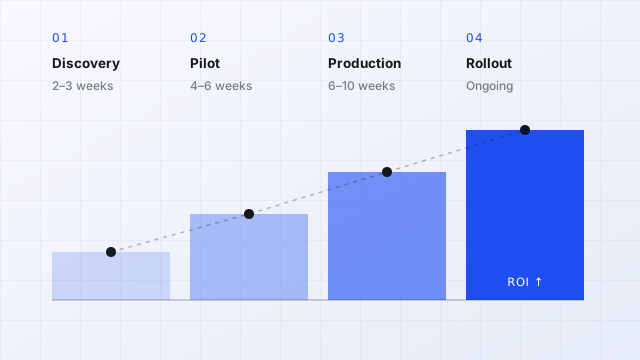
The full custom development process

Four delivery stages — Discovery, Pilot, Production and Rollout — each longer than the last, with return rising as the scope grows

Pick a scenario, not an industry

An industry solution is a starting point, not an answer. Tell us one concrete scenario and how it is handled today, and one meeting is enough for a feasibility read, the list of constraints and a first version of the acceptance criteria.